Thursday, November 12, 2009

“Queen Maeve’s Cairn, Knocknarea”:

Heroic tales and sagas vast
and courtly chiefs in their prime
The glory of the Tain's epic cast
and Cooley’s bull, remnants of time,
kindled I to climb hard and fast
slopes o' Knocknarea's trail,
moulded legends in their cast:
where myths are ne'er frail;
dreams bristled where flowers wave
Connacht’s Queen of Cruachan’s dale –
the warrior Queen Maeve –
laid under the moon's silver brail,
a giant cairn atop her grave?
A mound luted in mystery
entombs the heroine of history!

What pride of place for Ierne
in majesty of height, noble bearing,
with stone steep such stacking cairn -
Connacht’s Gaels, loyal and daring.
A monument built by clans and septs
defies like the horses' bit;
cloudbursts of pride dancing their sets
in the steps of stones are lit;
so great a mound this pilgrim found
such strength, toil and sage-like wit,
some noble lying on hallowed ground
to the immortal moons suffuse
atop Queen Maeve’s cairn my tears take muse……

20/7/2002
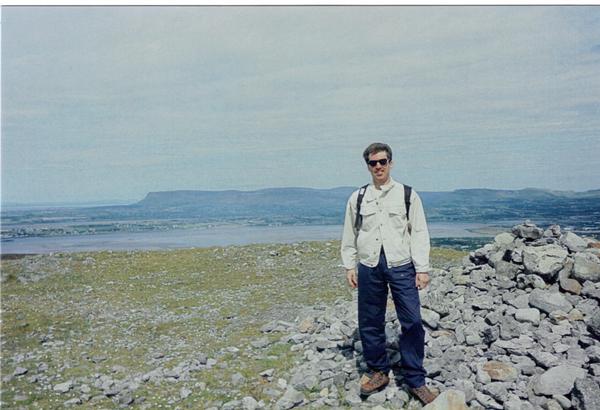

The Bardic Searcher standing on top of Queen Maeve's Cairn with Coney Island in the background.
 Footnote: Queen Maeve was the legendary Queen of Connacht who lead the Cattle Raid of Cooley, culminating at the Cooley Peninsula in County Louth - the 'Tain' - that epic from Gaelic mythology. It's said her quest for the mythical Brown Bull of Cooley was inspired by a bet she had with her husband, Ailill, as to, who had the most possessions! The Cairn itself (one of the largest, if not the largest in the province of Connacht) sits on top of Knocknarea mountain, offering spectacular views of the whole peninsula and both Coney Island and Carrowmore megalithic cemetery in the near distance!

Further footnote: Cruachan is in County Roscommon, a neighbouring county to County Sligo, where Knocknarea is. Cruachan was Queen Maeve's seat and also the seat of the Connacht royals, notably the O'Connor's.

www.stonepages.com

www.megalithomania.com

www.carrowkeel.com

Thursday, October 29, 2009

''The Linen Hall Library''

'The Linen Hall Library', is my favourite place in Belfast. Located just across from the City Hall in the City Centre, it's truly one of the jewels of Beal Feirste. Founded in 1792 by the 'United Irishman' Thomas Russell, it has connections with the aforesaid United Irishmen (this was the time when Belfast was known as ''The Athens of Ireland") and it was also in that year that the 'Harpists of Ireland' actually met and assembled within its walls - no mere claim to fame in itself! But before I continue, I'd like to talk about its founder, Thomas Russell; often called 'The Man from God knows where', because 'though a very captivating personality - who was hanged outside Downpatrick jail - he had an air of mysticism and could never be pinned down, so to speak! He defied caricature and stereotyping; he was very much an enigmatic character. But one thing that can be stated with certainty and moulded in stone is his vast intellect and his great pedigree as a Bibliophile! It's this, which is most striking about the Library itself: the tremendous archive of books it has, on History, Mythology, Antiquarian studies, Folklore etc which indisputably does justice to Russell's memory. One can obtain a Guest's pass and stay there as long as one wishes; I normally stay there all day and the time just wiles away...... Apart from this, architecturally, it's a lovely building and truly has history in the walls!! And finally, it has a very nice cafe/restaurant. If after visiting Belfast, you miss the 'Linen Hall Library', you have missed one of its authentic gems, much like when exploring a mystery you get to the outer shell but never get to the kernel of it! The Library is simply unmissable.

Friday, October 9, 2009

''Wicklow Jail''

Located in the county town of the county known generically, as 'The Garden of Ireland', this jail built in 1702, is yet another intriquing Irish prison with history, anecdotes, substance brimming from its walls, like a violinist with many strings to his bow!

It has been at the heart of events in Irish history like the 1798 rebellion of the United Irishmen, the 'Great Irish Famine', the 'holding area' for many poor souls about to be transported to Tasmania in the 'New World' for the merest misdemeanour like sheep stealing!

The period 1798/1803, saw many of Wicklow's rebel's spend time there. People like General Holt, Billy Byrne, Napper Tandy and it's also associated with the heroine Anne Devlin (Robert Emmet's noble and selfless servant, who never betrayed him!) and it's this part I'd like to talk about. Possibly two of the cells are haunted - one of which, Anne Devlin frequented when visiting her father, whilst held there after the 1798 rebellion.

It was whilst I was in this cell on a visit that, I had a very strange experience; my hand went numb and I got the feeling something like a needle was being inserted into it! Given the harrowing history of the place, the concomitant sorrow that was imbued in that cell particularly, could I have picked up on something? Perhaps Anne Devlin did knitting or embroidery when visiting the cell in the pre-1803 period?

The Jail is well worth visiting (the yard is an additional interest!) and if nothing else, be intriqued and mindful when visiting the haunted cells. Wicklow Jail is yet another doorway into Ireland's sad and heart rending history and the feature of Wicklow town!

Monday, October 5, 2009

''James Joyce - most revolutionary writer of the 20th century''

The novel, Ulysees, published in 1922, has been claimed to have changed the face of literature and to have revolutionised the novel in the 20th Century. The book is set on the day of June 16, 1904, and chronicles a day in the life of Leopold Bloom - a Jew - as he goes wandering around his native Dublin, much akin to the Greek epic, The Odyssey of Ulysees (Odysseus) from whom the novel takes its name. Joyce through the voice of Bloom, outlines the history of the Irish race, Ireland, Dublin, its streets, its sites, the commercial nexus of the city, its pulse, its epicentre, its veins and arteries; in essence, every component and part of the fabric of Dublin - of its topography - in voluminous detail. James Joyce's research and erudition is truly awesome (he studied the old ‘Thom's Directories' and detailed maps for years, which gave him this colossal knowledge). Herein lies the power and the influence of Ulysees: Joyce changed fundamentally the structure of the novel, he used no punctuation, to give it an uninterrupted flow - known as 'Streams of consciousness'; the wordplay and punning is infinite, done in a totally unique way. To cite but one example, Bloom breaks up the word Castile into cast steel and turns it into a punning joke: What do a Spanish Opera and Gibraltar have in common? Rows of Cast steel (Castile). It's these innovative verbalisings, fusions of linguistic expressions and colloquialisms, its encyclopaedic knowledge, which makes it one of the most influential novels that literature has ever been bequeathed. All that one ever wanted to know about Dublin and indeed Ireland, its history, its people, its culture, its idiosyncracies, its charms, its contradictions, its betrayals, its heartaches, can be found here narrated through the medium of Leopold Bloom in one solitary day. Small wonder that June 16, has been immortalised in the annual calendar as ‘Bloomsday'. Ulysees is totally unique, a pioneering work in English literature produced by an Irish writer in exile, which contains a wealth of information, linguistic flair, a descriptive genius, an intricate awareness of the layout of Dublin, its heartbeats, its resonances, its good and bad, its charm. James Joyce gave the world a modern odyssey of his native Dublin; indeed, Ireland as a whole could claim him as a great exponent of Irish genius! >

Wednesday, September 16, 2009

''The Hitler family's connections to Ireland''

A piece of quirky and interesting trivia is the fact that one of the most famous hotels in Dublin - the Shelbourne hotel, St Stephen's Green - has connections to the family of Adolf Hitler! Around 1910, the brother of ADOLF HITLER - Alois - worked there as a waiter; he had been sent there by an agency in England. It was whilst in Dublin, that he met an Irish lady called Brigid Dowling, at a Travel Fair; she fell in love instantly with this debonair, polished, smooth as teak sophisticate, who was posing as an inveterate traveller/adventurer of the world! From hence began a most interesting story! They duly married after a quickfire, whirwind romance, which would leave any Danielle Steele or Mills and Boons romance in the shade and went to reside in Liverpool, England.

Brigid Dowling herself claimed she met Adolf at their Liverpool home in subsequent years, having partaken in the felicity of a game of cards! From this union between Elizabeth and Alois, a son was born whom they christianed William Patrick Hitler! And this boy went on to lead a very interesting life indeed: first going to Germany, meeting his infamous uncle - whom at first he loved and cherished - then left for the US, having become antagonistic towards Adolf, ending up in the US Navy during the second world war!

So, the reputable Shelbourne Hotel, which has seen many famous personalities stay within its lush and salubrious interiors, was the starting point for a most compelling and little known saga: Ireland - Dublin - and the Hitler connection. Yet another reason why Ireland - and Dublin - are full of surprises waiting like the dropping of a hat around every corner....

Wednesday, August 26, 2009

''Tara is not just a hill!''

"Sweet Tara, may your heart preserve thee":

Oh sacred soul of Eriu's glades
holy hill with wisdom sage
sweet prophetess on the pilgrim's way -
Royal Meath's sweet repose.

Oh Tara beloved maiden -
still shine in eternal splendour!
Hill suffused in healing ministry -
its halo a fountain of love

Of the consciousness of the Gael
you are the true portal;
your mounds and boughs and barrows
heaving treasures of earth's arrows.

Hill adorned with green bastions
her fertile riches the temple of Danu;
beloved Tara whose glory confounds
as India's laws of Manu!
You're ageless like Fodhla's fruits -
the pantheon of High Hings' classical.

Sacred Schrine in the House of Royals
the mother Goddess at love's zenith.
Oh Hill of Tara! Oh holy Tara!
your mounds and barrows blest!

Psychic spirit resting mo chara -
a time tablet of Eriu's smiles
Oh motherland of nature's pilgrims
Sweet Tara! may your heart preserve thee!

The Mound of the Hostages, Tara Hill - second oldest astronomical observatory in the world

Footnote: Tara, County Meath, is the socalled ancient capital of Ireland. But alas the Tara Landscape, i.e. the Tara/Skyrne Valley, has been destroyed and plundered to make way for a two tolled motorway!! (http://www.savetara.com/      http://www.tarawatch.org/) Over 70 major archaeological sites were destroyed - 40 of which were new including the site of Lismullen astronomical Henge (one of the top ten discoveries in the world in 2007!); a gala complex of souterrains at Roestown, about which or its purpose, we'll never know now, Collierstown - very possibly and probably the burial grave of the Na Fianna Warriors killed at the Battle of Gabhra in 280; Baronstown ceremonial grave - the probable feasting ground and meeting place for the Harpists of Ireland, according to the Dindseanchas; and the gallows site of 1798 - Soldier's Hill, which is now the interchange; the searing of the outer extremity of the remarkable promontory fort, Rath Lugh etc

Further footnotes:
Tara Hill - which is the centre of this landscape - is where 142 High Kings of Ireland were inaugurated.
Danu is ancient Ireland's most famous Goddess and was the principal deity of the Tuatha De Danaan, the mythical people of ancient Ireland.
Fodhla (representing justice) is one of the triple Goddesses of the Tuatha De Danaan: Eriu, Banba accompany Fodhla, who it's believed welcomed the Milesians (the Gaelic people) when they arrived here.

The Gabhra River and lovely quaint bridge - about the only pristine part left of the Tara/Skryne Valley

www.skryne.com 

''The wisdom of ancient Irish Pagan sites!''

The many hues of Brigid

From the bowels of mother earth, the Goddess Brigid, is restless as a ship at sea. Her birthplace at Faughart, Co Louth, where her well is believed to be, and her last place of abode, Cill Dara, are like lost children in a land cut from its roots. Brigid the great initiator of the re-birth and awakening of nature, the great shepherdess reaping the seeds of fruitfulness, of bounty, of bliss, of maternity, of fertility, of harvest time, the foundress of the fountain of everlasting life, when Spring rises up from the caverns of winter, is bewailing the sad plight of Eireann's heritage and its vernal, vibrant, verdant swathes, all abused by man's brutal, ruthless avarice; stamped and trod upon by the tyrannical ploughshare of modern man's heretical ways. Her face is now lined and cracked, weary from lamentation - a silhouette of the earth's stricken sphere being eaten up by the licentious Leviathan. Brigid the great patron of the Arts, whose great foundry could smelt the driest and weakest iron into action; into a charger of creativity, of miraclulous wonders, of prodigious plenty; whose forge was the source, the provenance of all that was good, beneficient in its loving kindness, the positive protectress, the benevolent particle of truth, is waiting patiently in the shadows, in the underbrush, in the chasms of the underworld for our call, our deepest supplication for her to light our way again; to ignite the fires of wisdom, enlightenment, clarity, and clasp us in her loving embrace. Brigid the silversmith in the effulgent freshness of sweet creation, her anvil - the anvil of infinite creativity, a spark for the beauteous saga of Gaelic Ireland, a time when Eireann was in its prime; the halcyon horizon was in her smile - her vivacious being. The sweet silversmith of holiness; her mind cleaving to the highest murmurings of life, creation and mystery - her great and auspicious time - is nearing and fast approaching! Will we welcome the great Brigid again and bow to her chaste and noble sublimity, like honourable knights of old; hear her lament in the wilds of Connemara, in the winds of Antrim's Glens, in the shrill bellowings of the great Atlantic Ocean and the Irish Sea like Manannan of old, demanding that we respect the mother, the great nurturer and stop her wanton violation now? Time is of the essence; if we don't heed her lament now, dear mother earth and the once, pristine kaleidoscope of Eireann's green baize, will be interminably damaged and Brigid will become dumb and mute in the crazed cacophony of modern man.. Footnote: not only does Brigid have associations with Faughart - as the previous blog - but Kildare and Kildare town, in particular as well!