Tuesday, August 31, 2010

"On the trail of the Black Madonna"

There are two Black Madonnas in churches in Ireland; it was the one in Thomastown, county Kilkenny, that I went to see on a salubrious August day! Before I begin, let's be clear on what a Black Madonna is!! Quite simply, a Madonna figure, carved in Oak, either dark mahogany hued or ebony black; clearly, they are not depictions of Mary the mother of Jesus. Who they might represent, I'll discuss at the end!

So I hitched my way from Kilkenny - about 10/11 miles, passing over the lovely river Nore, before Bennettsbridge, which offers a lovely view of the Mill and its Pottery Crafts shop owned by the Mosses; and my target was the local church of Thomastown - the Church of the Assumption. It was very easy to find, as it stands on a slight hill overlooking the town (there have been a few churches there - one of which was used during Penal times, but they were subsumed into the current building which dates from the second half of the nineteenth century).

The Madonna - called ''Our Lady of Thomastown'' can be seen as you enter the church, to the left of the Altar, beside the statue of Jesus. It is a beautiful carving, not coal black like the one in Dublin, and unusually she is not sitting as many of them depicting her, tend to be. I thought of my many journeys in the Languedoc and Midi region of the south of France, as the Black Madonna is so associated with there - famous ones like at Rocamadour and the Abbey 'Notre Dame de Marseille', outside Limoux, came to mind (sadly three years ago that Madonna was badly destroyed - severed at the neck either by a treasure hunter, or someone who was making a statement; this fate has occurred to other Black Madonnas throughout the centuries in different places, either destroyed or suffering the ignominy of being buried!). I marvelled at the visual phenomenon; the carving and craftmanship was of the highest standard - works of art really - and with all due respect, demonstrate far better workmanship and artistry than statues of Mary the mother of Jesus (the Virgin Mary).

Our Lady of Thomastown looking resplendent!
Upon reading the text, I came across a coincidence, which was another link with the Languedoc. According to tradition, it was brought back from Spain around 1666 by a local wine merchant called Patrick Lincoln! It was then my mind wandered again; I thought of the enigmatic book "The Holy Blood and Holy Grail" about the mystery of Rennes-le-Chateau in the Languedoc, one of whose co authors was Henry LINCOLN, and found the name coincidental. It'd be interesting to ascertain if the Patrick Lincoln of Thomastown, was looking or searching for anything, under the pretext of a business trip. And it'd be interesting to know in what part of Spain, was the carving found!? (Perhaps in Cataluna!)

A final bit about this beauty of unknown and hidden Ireland and spiritual iconography is that, it was adorned with a crown of silver stars, which according to the story, were either stolen or traded by a priest for a plate!! (It would look strange to have two "Queens of Heaven", on display, would it not, me thinks?)

So I sat down and did a meditation, and the words Isis/Magdalen, kept thumping in my ears, as if some message was being relayed to me. And these, of course, are the two personages, most widely cited, as the inspiration/muse for these most unusual statues and carvings (in the Languedoc and the south west of France, they are believed to represent the Magdalen herself!)
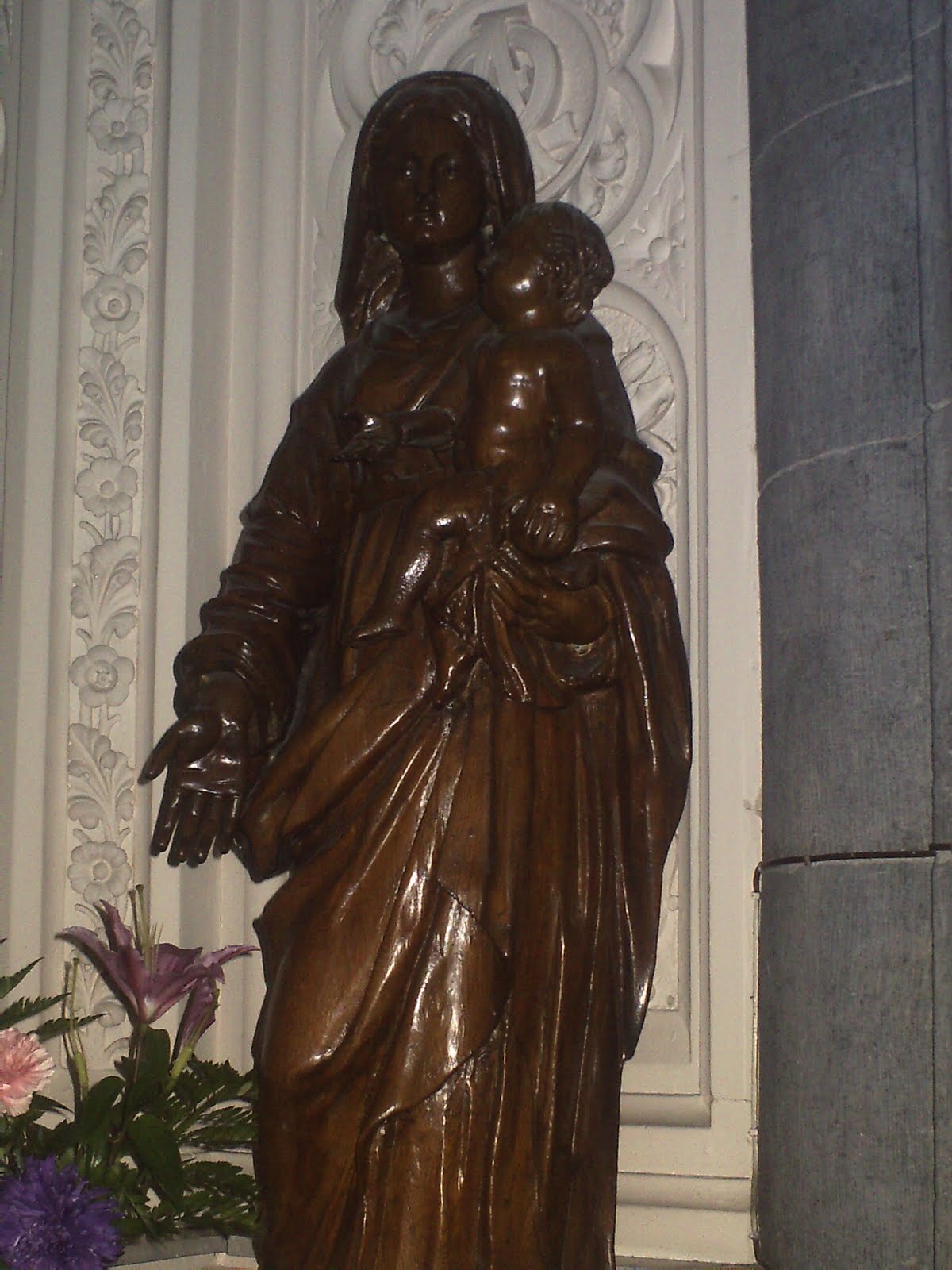
     

The Black Madonna in regal pose!
So what a lovely day it was; I felt I had conquered another chapter in my long quest for truth. I left very moved and now thought: as I've seen the only two of these wonders in Ireland, I must see more of them in the aforementioned Languedoc in the south west of France! Certainly the "Black Madonna of Thomastown", is a beautiful piece of carved oak, produced with great zeal, fidelity and consumate craftsmanship, by someone who wanted to preserve the memory of another Madonna!

Final word: Thomastown is a very nice and quiet village; and there is also a disused ruined church from the Penal times! So Kilkenny is not just about its city; but has a number of quaint towns, one of which is Thomastown, whose emblem is "The Black Madonna"!

Tuesday, March 23, 2010

"The Cave of the Cat":

Ownee na Gat - entrance to the Otherworld for the ancient Gaels - is perhaps the strangest place in Ireland; a complete enigma, a place beyond comprehension! On the Plains of Cruachan in the townland of the same name, county Roscommon, the demesne of the Connacht royals, it would seem to be aligned to Rath Cruachan itself - the principal Rath of the Connacht Royals! But it's more than just a souterrain, it goes right down into the subterranean chasms, as if some snake plunging headfirst through the Roscommon earth.
Ownee na Gat - Entrance to the Otherworld
But it's its contents, its composition, which is the first of its wide-eyed cornucopia. It seems to hit one in the gut, as if something visceral is at work - as 'though the resonant rapture of wisdom ancient is being illuminated and echoed in the walls. It seemed on one level, not only were the entrails of Mother Earth being shaken and poured from some invisible goblet, as being drained from a tin can, but also my adult consciousness, and hence I had returned to the larvae or bubble and was in my mother's womb again! As if I were floating in water - pacific and tranquil waters of purity, so much so. I had no feeling of claustrophia and indeed didn't want to leave.

The structure and topography of the Cave is most unusual and is another Iris in the wider-eyed cornucopia; the walls, for instance, are layered and textured like the pipes of an organ or like a series of fluted canisters or tubular bells. Could the walls have been stripped by mortals in ancient times, or is it something otherworldly or at least a cameo kaleidoscope of the otherworld! On the ground, I found a stone - not embedded in the ground - but loose - sitting on its side which was either a carving of a Pig, a Cat or a Bull! And then there was the strange mist that appeared in the first picture, I took inside, which appeared to trace the outline and shape of a human!

Outline or body shape? This image was taken  when I was looking down the passage from the end of it. I had just sung a song and recited a poem. My friend was at much further down. 


Could the cave represent a kind of re-birth, re-generation of the individual? A parallel with one interpretation of the Lazarus story - that when going in there, one was metaphorically dead, and when one came out, one was re-born, born again, renewed? The Folklore of Ireland's Saint Patrick, in his cave on Station Island is slightly similiar. (This concept, having been perpetuated from Pre-Christian belief systems). The idea of being plunged into something - full imersion - could also be signified, much like the penitent being plunged into the baptismal waters of renewal (perhaps I touched on that, in my feeling of 'Floating in water'?).

But it would be amiss of me, to not consider the possiblity of it, being a place of initiation and entry for the Royals, given its not more than 100 metres from Rath Croghan. The High King of Ireland, when crowned at Tara, was deemed to be wed to the Mother - the earth. Could the same thing have been at work here for the Connacht Royals? (It's interesting to note there are possibly more Raths in Roscommon, than any other part of Ireland!).

The Cave of Ownnee na Gat is one of the strangest, most curious and logic defying places in Ireland. If one throws into the melting pot, the likelihood that the epic tale from Gaelic mythology 'The Tain' (the 'Cattle raid of Cooley', featuring the Queen of Connacht, Queen Maeve, and the legendary Cu Chulainn) started around here, it's easy to conclude that this was a very important and special area. The Cave of Ownee na Gat could be a real candidate for the erstwhile TV series 'Ripley's believe it or not!'

In the heart of the souterrain - is that an orb?


"The Oarsman":

The oar's angle skimming
the lake's azure pure marble;
As a Barber clip clop trimming
trough swishing - sighs his warble.
Oarsman rowing, ring running,
round ripples as laying corbels
Strokes sighing, sounds punning
cultivating acts with cunning.

Rowing Boat swaying on its back
as clutching the banner spangled
in blue and silver, making track,
as 'though the lake nymph ogled
Oarsman raking hay to sack
the oath Olympic horn bugled!

No flailing arms or wings dishevelled
as music and sport he pulls
From a crowd of waves revelled
his double entendres, nimbly culls!
No time to double O'ER and hunch
as the beams he jousts inch by inch........

Monday, March 1, 2010

''The Curragh & the only outdoors Boxing Monument in the world!''

Lying in what's called 'The Hollow' in that unique landscape called 'The Curragh' in County Kildare (neighbouring county to Dublin) is a quaint and unusual monument. It is a monument to the famous Irish Boxer of the early 1800's, Dan Donnelly, who beat the best boxers of Britain at that time; it marks the exact spot in 'The Hollow' where he beat Tom Hall and then George Cooper in front of 20,000 people; the monument's inscription reads: ''This is where Donnelly beat Cooper in 1815.''  As such, it's probably the only outdoors monument to a boxer in the world!

'The Hollow' in the Curragh - scene of Donnelly's greatest epics!
Propped like a sentinel from a distant epoch, in the heartland of 'The Curragh', it offers an opening into a piece of Irish sporting lore and history and heritage. (Donnelly himself was buried in Bully's Acre, Kilmainham, Dublin, not too far from where he was born!) and his prized arm was actually severed from his body by a surgeon after grave robbers plundered it! From 1953 to 1996, this arm was exhibited in 'The Hideaway' pub in Kilcullen before taken to America!! One legend attributes the arm as the longest in boxing history, and that he could stretch his arms past his knees without bending his legs!

The Curragh landscape itself is a landscape of pleasant green plains which stretch out like a silk canvas smoothened and iron pressed around Kildare town across to near the Bog of Allen. Legend has it that on Feb 1, the day of the sacred Brigid, that she laid her garment out around Kildare, which mystically formed these plains! It therefore seems fitting that Donnelly's greatest hours took place within these plains and 'The Memorial' to Donnelly is yet another reason to behold their rich texture!

Small wonder the song, 'The Curragh of Kildare' says:

And it's late I will repair
to the Curragh of Kildare
for glad tidings you'll find there!

The Plains of Kildare where you'll find glad tidings!

Tuesday, January 26, 2010

''Glasnevin cemetery and the grave of Roger Casement''

Glasnevin cemetery is a huge cemetery where over a million people are buried - many of whom are famous Irish people. In 1966, the remains of the patriot and outstanding international humanitarian Roger Casement - who was executed for trying to import guns to Ireland for the 1916 rebellion or more precisely treason against the realm - were disinterred from Pentonville Prison, London, brought back to Ireland and re-interred in Glasnevin Cemetery, Dublin. However, his wish that he lie at the home of his paternal relatives and ancestors by Merlough Bay in County Antrim in the north east, where he spent many childhood summers wasn't fulfilled!

There was a tree beside his grave which looked totally out of place, as if it bore a burden or was trying to convey a message. I was moved to write this poem consequentally upon beholding this sad tree back in 2003/04!

"The tree by Casement's Grave":

There is a tree o'er Casement's grave
which blooms not in royal garb
no canopy of lush green
of leaves bristle sweet barb

There is a tree withered and wan
whose shadow has no bloom
o'er Casement's grave it hangs
like a bride without a groom

There is a tree of little colour
that sprouts not nature's leaves
it's all but dead and forlorn
its mass stoops and grieves

There is a solitary tree
near Casement's resting place
the only tree which holds not
to its birth with pride of place!

It does not blossom in the day
its season is a spring that's spent
nor does it swivel in Summers bright
but fades like a captive bent

There is a lifeless tree
watching o'er Casement's grave
it shakes not gilded shrubs
nor buds finest of the brave

Its boughs and trunk
preserve a great shock
they feel the pain of Casement
for he wished to lie by Merlough!

Footnote: As the Tree is now gone, to make way for the restoration of the Cemetery, perhaps the poem is now pointless, or should a new tree be planted sometime again by the grave!?

Wednesday, January 6, 2010

''Prose for an Irish Folk Singer''

Liam Clancy came at a time when Irish Folk Music was arguably dead! It was the dawn of the decade of the 60's - before 'Planxty' or 'The Bothy Band' came on the scene and even before 'The Dubliners'; the decade of 'Flower Power' was yet to weave its psychedelic loom; the Beatles were yet to take the world by storm; the decade of the seminal 'Woodstock' festivals had still to be seen; that prodgious wordsmith, troubadour and rebel artist, Bob Dylan, had just started hewing great hollows out of the status quo's rocky strata - both Joan Baez and him embedding adamantine rocks on the plains of indifference; and it was the decade of the twin Civil Rights movements of the US and Ireland, about to illuminate their pristine Summers on Winter's evergreens.

So this was the backdrop for Liam Clancy's burgeoning emergence on the Folk - ultimately - world scene; his first incarnation if you like, as a member of the Clancy Brothers! From the outset, the Pioneer's paths were staked out, as musical strategists on a mission, reconnoitring the uncharted territories, the forgotten vistas of Minstrelsy! The raucous and boisterous harmonies, conjuring up images of Fishermen docked at some port of Newfoundland, lifting the rafters of a local pub, or some Whalers out of a Moby Dick Film in port at Nantucket Bay, raising the decibels to the High Heavens of some tavern; the Aran Sweaters - their omnipresent attire; bedecking and serenading the spirits haunting the halcyon echoes of Carnegie Hall and the very lyrical and soulful vocals of a young Liam, so smooth and unwavering, as if conjuring a vessel at sea in the balance of the waves and the even keel of its voyage!

The Irish Folk music scene - if not dead - was certainly moribund in the 60's; for it was an emasculated shell in comparison to the English Folk scene of the time, which was riding high in the North of England. But that all changed with the Clancy Brothers; they resurrected Irish Folk music from the giant crater, where but laconic dreams resided; from the still waters where but the shadows of the Bards and Minstrels and Balladeers could be seen; they navigated the Backwater Straits of the Folk Culture of the Gael; gave it a force again. The great art of the Irish Celt (the Gael) was resplendent again as if the Emerald Isle were given an extra sheen of green!


That great and effervescent South Armagh Ballad Singer (who would carve his own niche as an Irish Troubadour), Tommy Makem, joined ranks and the Clancy Brothers continued on their merry way! Eventually, they broke up and Liam and Tommy Makem limbered up as a musical duo or a stage act revolving around the repartee of Liam and Tommy; then the four ultimately re-united for a series of concerts in the 80's - this was Liam's second incarnation! It didn't take long for this limbering up between Liam and Tommy to become a fully fledged and potent dynamic on the Ballad and Folk scene.

The visual accoutrements were retained: the ubiquitous Aran Sweater - now having become almost a fashion statement or the emblem of the Gael - and the cap, the sailor's cap, once again the iconography of the Aran Fisherman and his journeyings. And the musical duo's act was a perfectly balanced juggling act, in exact symmetry; a selfless operation at work. They both complimented each other and allowed the other to express the full gamut of their craft and abilities, as they were very clearly the main men now in this re-uniting!

In the latter part of Liam's life and career, he went solo - this was his final incarnation. His stage performance having the wee bit of magic in it - a seeming magician at work, who could orchestrate and whip up an audience, at his whim and will. His timbre and song delivery - befitting a Songster in full possession of his faculties and at the zenith of his powers - as crisp as an Irish turf fire being prodded and nurtured along to full glare and heat! Then the poetry, recited the way poetry should be recited - fluid like Guinness flowing endlessly from the taps or milk running down the back of a milk churn which has overflowed! And the other ingredients of his act - the pathos and reminiscences remaining indelibly engraved upon the mind's eye!

In the end, he lived his final days, as aptly and appropriately as it should have been; narrating a documentary about his life in the true Narrator's style! It was called The Yellow Bittern and the Bittern sure sang for him in his life, his chosen vocation and at his time's end. In the words of Bob Dylan: 'The Greatest Folk/Ballad Singer in the world!'

Footnote: The Clancy Brothers were born in Carrick-on-Suir, Co Tipperary and were buried in Rinne, Co Waterford and Tommy Makem hailed from Keady, Co Armagh or the republic of South Armagh, as he said.


Tuesday, December 8, 2009

''The Louisburg Famine Walk''

This Walk organised by Afri has taken place every year since 1988 on the last Saturday of May in West Mayo. It starts ten miles from the village of Louisburg at Doolough on the Leenane Road and goes into Louisburg via the Doolough Valley, following a narrow road which flanks moody mountains nearby. It commemorates the walk that the beleagured folk and denizens of County Mayo took in 1849 during the height of the Irish Famine - they were sent to Delphi Lodge ten miles away to receive food, were denied entrance and had to turn back; during which many fell by the roadside; a similiar scene which was replicated and visited in many parts of Ireland, especially in 'Black '47'.

But what makes this Walk special, is that every year a representative of the Choctaw Indians - a Native American nation - comes on the walk; this is a unique continuance of an Irish/Choctaw connection since that time - an unbroken continuum......... It was during the Great Irish Famine in the aforesaid 'Black '47', that these Choctaw upon hearing of this cataclysm where so moved, they collected 710 Dollars and sent it here. Having endured 'The Trail of Tears' in 1831 - their own Famine - they knew exactly how the beleagured Irish felt!

This year's walk was particularly moving as a man from the Niger Delta also came to demonstrate his solidarity and remembrance of the Famine Walk; thus forging a cross cultural/ethnic dimension to it all.
The Walk itself is tough but how tiring, depends on your fitness, but it's  well worth doing and immensely rewarding; you'll feel renewed and reinvigorated as if having done a Pilgrimage; in addition, I also found it incredibly moving. Just after the start, you'll pass by an evocative stone memorial to those who fell there on that day! It is imperative to stop here, reflect, ponder, and contemplate. I myself did a small prayer and invocatory poem. But at least honour it with your presence and silence!

http://www.thefullwiki.org/Doolough_Tragedy

'The Louisburg Famine Walk' is one of those 'events' that one has to do at least once in one's lifetime, much like climbing the mountain of Croagh Patrick on Reek Sunday, at the end of July; whether Irish, of Irish roots or ancestry, or just a history lover, a serial walker or a visitor to Ireland looking for, a profound experience to take with you, it's a challenge that needs to be encountered and experienced! On the way, you'll see some enchanting mountains, a deeply beautiful but desolate landscape and in the howling winds, you can almost hear the sighs of the Banshee and the spirits of the hungry ones!!


Thursday, November 12, 2009

“Queen Maeve’s Cairn, Knocknarea”:

Heroic tales and sagas vast
and courtly chiefs in their prime
The glory of the Tain's epic cast
and Cooley’s bull, remnants of time,
kindled I to climb hard and fast
slopes o' Knocknarea's trail,
moulded legends in their cast:
where myths are ne'er frail;
dreams bristled where flowers wave
Connacht’s Queen of Cruachan’s dale –
the warrior Queen Maeve –
laid under the moon's silver brail,
a giant cairn atop her grave?
A mound luted in mystery
entombs the heroine of history!

What pride of place for Ierne
in majesty of height, noble bearing,
with stone steep such stacking cairn -
Connacht’s Gaels, loyal and daring.
A monument built by clans and septs
defies like the horses' bit;
cloudbursts of pride dancing their sets
in the steps of stones are lit;
so great a mound this pilgrim found
such strength, toil and sage-like wit,
some noble lying on hallowed ground
to the immortal moons suffuse
atop Queen Maeve’s cairn my tears take muse……

20/7/2002


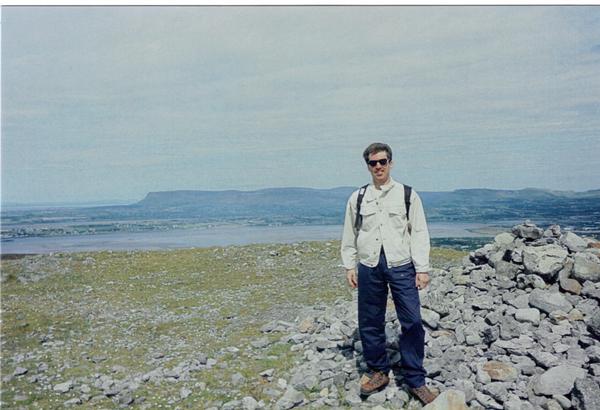
The Bardic Searcher standing on top of Queen Maeve's Cairn with Coney Island in the background.
 Footnote: Queen Maeve was the legendary Queen of Connacht who lead the Cattle Raid of Cooley, culminating at the Cooley Peninsula in County Louth - the 'Tain' - that epic from Gaelic mythology. It's said her quest for the mythical Brown Bull of Cooley was inspired by a bet she had with her husband, Ailill, as to, who had the most possessions! The Cairn itself (one of the largest, if not the largest in the province of Connacht) sits on top of Knocknarea mountain, offering spectacular views of the whole peninsula and both Coney Island and Carrowmore megalithic cemetery in the near distance!

Further footnote: Cruachan is in County Roscommon, a neighbouring county to County Sligo, where Knocknarea is. Cruachan was Queen Maeve's seat and also the seat of the Connacht royals, notably the O'Connor's.

www.stonepages.com

www.megalithomania.com

www.carrowkeel.com