Creggan: An Creagan
Directly halfway between Omagh and Cookstown in the north of County Tyrone, at the foothills of the Sperrins, is an area which is like a gaelic, cultural and archaeological gala; the place is called Creggan (an Creagan in Gaelic meaning rocky or barren place) - it is one of three places in Ulster called Creggan. In many ways, it's yet another part of hidden Ireland; hidden Ireland being the target of my quest for ten years and the purpose of this blog!
Until circa 1940, there was a Gaeltacht in this area, and it died when the last speaker Peadar Joe Haughey passed away (coincidentally and intriquingly, another Gaeltacht in south Armagh at another one of Ulster's Creggans (which has been blogged here earlier under unique enclave for Gaelic poets) died at the same time!) Both Gaeltachts were badly treated and in many ways, shafted by the Board and Department of Education in the north of Ireland in the 20's and 30's; arguably it was part of a coherent and strategic anti-Gaelic policy, to render them dead and gone! Now, there is but one Gaeltacht in the six counties in the north - in west Belfast (sprouted up in the last few decades). The cottage of Peadar Joe Haughey can be visited and is restored and displayed, as it was when he lived in it!
VESTIGES FROM THE ANCIENT PAST
The landscape around here is dotted with megaliths consisting of: Cairns, Wedge Tombs, Stone Circles, Raths, Court Tombs, Portal Tombs (Dolmens) etc. For instance, to the west of the enchanting Visitors Centre is Aghascrebagh Standing Stone, the only standing stone in County Tyrone which has an ogham inscription; Dunnamore Wedge Tomb, is also known as the Giant's Grave (such an interplay of names happens in many different places in Ireland); and approximately six miles from here is the famous Beaghmore - three pairs of Stone Circles, a circular setting of upright stones, along with five small cairns! It is the largest in Ireland! It was one fair september day, some years ago, that I went a-looking for them, as part of my megalith hunting pursuits. They are so hidden and hard to find, it's like they are covered by some invisible covering; perhaps a great pair of binoculars would have helped or just some eyes with xray vision. I walked around as one doing a series of ceremonies encirling the epicentre or a baby crawling around the navel of its father's belly - as if circumnavigating the central cog of a machine but to no avail. I was encircling the fields as if wrapping them in my breast; I was ekeing out every nuance of the countryside - so much so, that even 'though, it is a very remote and untouched area, I attracted the attention of an elderly couple - the man actually watching me with binoculars from his doorstep (I should have asked him for a loan of them when I went over to have a wee chat!).
The area also has a bogland landscape, which is a unique bogland in Ireland. The most typical type of bog in Ireland, is the one that's found in Connacht; this one is different. And the aforementioned Visitors Centre is located at the heart of it; there are some great walking treks and routes going from the Visitors Centre around the bog, like spokes from a wheel. It's such a pleasant and enjoyable ramble to inhale the smoky, pungent bog aromas around here, much like inhaling the aromas of Ireland at the dawn of its being (especially as so many of Ireland's bogs have been destroyed - up to 80%!); indeed, one can rent cottages here, called An Clachan Self Catering Cottages, which contain a traditional feature of a cul-tighe (cultyee) in the kitchen - basically, a dual purposed contraption, which fronts as a seat during the day and a bed by night!
Finally, An Creagan Visitor Centre/Bar is an excellent venue, with a beautiful, sanguine fire, which would warm the coldest of hearts and render them sentient beings of indomitable warmth! It offers an inside track, an inner sanctum, an unseen door into the traditional gaelic culture of the area; evenings of traditional music, storytelling and song are regular eye and ear catchers throughout the year and live music features each weekend.
The area called the Creggan is like a Gaelic Gala in the Sperrin foothills of Tyrone, which in many ways is not only a part of hidden Ireland but is hidden County Tyrone as well! It is an authentic and vibrant place, much like, places one finds on the Ring of Kerry - as if time locked; and a flagbearer of the Ireland that is being rapidly lost in the modern, materialistic society of today.
www.an-creagan.com
Friday, January 14, 2011


Wednesday, January 5, 2011
"County Cork - The Battle of Kinsale"
The Bay and harbour of Kinsale, is not a hidden sight but a very important site; for it’s here one of the most important battles in Irish history had its launching pad . Beginning on Christmas Eve (Some sources say the dates were mixed up - as there was a discrepancy over the calendars used, having the battle beginning in 1601 and other sources saying 1602!), it was the most decisive battle in the Nine Years War. The only defeat endured by the Ulster Chieftains, the Earl of Tyrone, Red Hugh O’Neill and the Earl of Tyrconnell, Red Hugh O’Donnell, the defeat resulted in a seminal event in Gaelic Ireland five years later, “The Flight of the Earls”, and hence the battle signalled the end of the Gaelic System and way of life! So the place could be described as the alma mater of the gaelic raison d'etre.
The circumstances of the battle are tinged with a number of ironies and what if’s, if only’s etc – something that has often been uttered and proclaimed at different junctures in Irish history, and would make one wonder, if history really does repeat itself! And also makes one pose the question: where is the veracity in that cliche: “The luck of the Irish”? For, the Spanish had already arrived there - since october - and were under siege (the place of landing was meant to be on the west coast, so even before it began, it was a bungled fiasco); consequentally, O’Neill and O’Donnell marched 300 miles, to rescue the beleagured Iberians (who were supposed to be the aid bringers!) – the stage was set for a military charade and if it wasn’t a real event, it would be portrayed as a tragi-comedy of immense and monumental proportions.
IRISH HISTORY REPEATING ITSELF AND THE REFRAIN OF WHAT IF!?
Of course during the 1798 rebellion, if Lord Edward Fitzgerald (with his intricate, three pronged military strategy of attack on Dublin), hadn’t been captured and mortally wounded before the rebellion, and if Wolfe Tone hadn’t been captured at Lough Swilly, the rebellion could have followed a different course, and indeed Irish history! And so the same thing can be said of the Battle of Kinsale; for the irony of the wrong place, the wrong time, the timing out of sync, was as glaring as a sun turned red, and the cruel fates that sprinkled their wares there, were as cruel as a vindictive tyrant roaming out of control! Fiasco was juxtaposed with a barrel of vile fortune.
Donal Mor O'Sullivan held out, waiting for more Spanish to come to regalvinise his defiance but ultimately the highlight or lowlight of the aftermath of the Battle of Kinsale, resulted in a legendary march called the March of O’Sullivan Beare in December 1602 - a gallant and heroic retreat amid the inclement and vicious winter of late '02 - from Cork up to Leitrim, after which only a mere 35 surivived out of the 1,000 that set out!
Kinsale - its coastline, the bay and the harbour but particularly the Bandon road - the actual battle site - is a place at which surely many spirits haunt, much like Culloden Moor in Scotland; for both locations saw the final curtain drawn on the Gaelic ways of life in each country. And moreover the place and battle site is a testimony to “THE BAD LUCK OF THE IRISH!”. Rather than just explore the touristy town, one needs to grasp this soul resonator of Ireland’s history - the site of the Battle of Kinsale.
“The day our kingdom died”
The winds changed like fickle Gods
and the seas rose up
like whipping rods
around the Bay of Kinsale;
the seagulls and swallows warmed
to the coming of the Gaels
the elements in strains
flickered for an eternity;
motion and time's warring trains
and the Clans fraternity
made shadows on the waves!
Alas! the seas were blighted
and troughs on the waves
no MORE Spanish ships were sighted!
Doomsday blazed in the sun
and the Munster sky strayed out
o'er the Kingdom of McCarthy
Armageddon's roots played out!
The two 'Red' Princes -
wind pacing to a halt -
their destiny locked in clinches:
O'Neill and O'Donnell
the twin maelstroms in twain
Tir Eoghain and Tir Connell!
Nature hung back
and clouds waited for the pall,
in dread of the battle's smoke
the clamour of the squall;
the two maelstroms held back
the fullness of their fall
infinitely waiting WAITING
for more Iberian ships
to answer the Gaels call!
Ah too late anchored the slips
too long the Princes did stall
and hence the Earls set sail
when the Gaelic life died at Kinsale!
* The above poem was written on the 400th anniversary of the Battle of Kinsale, January 2002.
The circumstances of the battle are tinged with a number of ironies and what if’s, if only’s etc – something that has often been uttered and proclaimed at different junctures in Irish history, and would make one wonder, if history really does repeat itself! And also makes one pose the question: where is the veracity in that cliche: “The luck of the Irish”? For, the Spanish had already arrived there - since october - and were under siege (the place of landing was meant to be on the west coast, so even before it began, it was a bungled fiasco); consequentally, O’Neill and O’Donnell marched 300 miles, to rescue the beleagured Iberians (who were supposed to be the aid bringers!) – the stage was set for a military charade and if it wasn’t a real event, it would be portrayed as a tragi-comedy of immense and monumental proportions.
IRISH HISTORY REPEATING ITSELF AND THE REFRAIN OF WHAT IF!?
Of course during the 1798 rebellion, if Lord Edward Fitzgerald (with his intricate, three pronged military strategy of attack on Dublin), hadn’t been captured and mortally wounded before the rebellion, and if Wolfe Tone hadn’t been captured at Lough Swilly, the rebellion could have followed a different course, and indeed Irish history! And so the same thing can be said of the Battle of Kinsale; for the irony of the wrong place, the wrong time, the timing out of sync, was as glaring as a sun turned red, and the cruel fates that sprinkled their wares there, were as cruel as a vindictive tyrant roaming out of control! Fiasco was juxtaposed with a barrel of vile fortune.
Donal Mor O'Sullivan held out, waiting for more Spanish to come to regalvinise his defiance but ultimately the highlight or lowlight of the aftermath of the Battle of Kinsale, resulted in a legendary march called the March of O’Sullivan Beare in December 1602 - a gallant and heroic retreat amid the inclement and vicious winter of late '02 - from Cork up to Leitrim, after which only a mere 35 surivived out of the 1,000 that set out!
Kinsale - its coastline, the bay and the harbour but particularly the Bandon road - the actual battle site - is a place at which surely many spirits haunt, much like Culloden Moor in Scotland; for both locations saw the final curtain drawn on the Gaelic ways of life in each country. And moreover the place and battle site is a testimony to “THE BAD LUCK OF THE IRISH!”. Rather than just explore the touristy town, one needs to grasp this soul resonator of Ireland’s history - the site of the Battle of Kinsale.
“The day our kingdom died”
The winds changed like fickle Gods
and the seas rose up
like whipping rods
around the Bay of Kinsale;
the seagulls and swallows warmed
to the coming of the Gaels
the elements in strains
flickered for an eternity;
motion and time's warring trains
and the Clans fraternity
made shadows on the waves!
Alas! the seas were blighted
and troughs on the waves
no MORE Spanish ships were sighted!
Doomsday blazed in the sun
and the Munster sky strayed out
o'er the Kingdom of McCarthy
Armageddon's roots played out!
The two 'Red' Princes -
wind pacing to a halt -
their destiny locked in clinches:
O'Neill and O'Donnell
the twin maelstroms in twain
Tir Eoghain and Tir Connell!
Nature hung back
and clouds waited for the pall,
in dread of the battle's smoke
the clamour of the squall;
the two maelstroms held back
the fullness of their fall
infinitely waiting WAITING
for more Iberian ships
to answer the Gaels call!
Ah too late anchored the slips
too long the Princes did stall
and hence the Earls set sail
when the Gaelic life died at Kinsale!
* The above poem was written on the 400th anniversary of the Battle of Kinsale, January 2002.
Thursday, December 9, 2010
"The three enigmas of Ireland, astronomy and space"
Meteorites: the great conundrum
Meteorites are one of the great conundrums or phenomena of astronomy, mysteries and enigmas of antiquity. They have perplexed and been revered by many ancient cultures around the world: regarded by some as 'Gifts from the Heavens' or thrown to earth as gifts; the Greeks used them in the Temple of Delphi and their chronicles are sprinkled profusely with references to them and their sacred importance; the famous Ka'aba in Saudia Arabia, where Muslims do the pilgrimage of Mecca is believed to be an ancient meteorite; hence, a meteorite was regarded and revered as a sacred stone, and those who possessed it could wield much power and impact (excuse the pun) upon their life and environs. Native Americans regarded them as so sacred – particulary the Navajo and Hopewell culture – guarding them with a vigilance as if guarding a mystical Grail, Ark or Philosopher's Stone – that they even deposited them in graves and hid them beneath rocks (1). And some Christian Fundamentalists interpret the Book of Revelation chapter 6 Verse 13: “And the stars of heaven fell unto the earth, even as a fig tree casteth her untimely figs, when she is shaken of a mighty wind”, as alluding to Meteorites (and of course a gigantic meteorite caused the manifold landscape destruction at Tunguska in Siberia in 1908). So it was when, at least the third Meteorite of 2010, hit Ireland on the evening of November 28, that I decided to explore their enigmatic pricelessness and write this article. For to quote John Milton in his famous poem Paradise Lost: “Lucifer shone..... like a meteor in the flaming air”.
The first meteorite to hit Ireland this year occured on the evening of Feb 3 at 6 PM. It was seen by many people around the country (2). (And as a curious example of serendipity, synchcronicity or bizarre coincidence, I was travelling in a car with a friend in County Leitrim and having a conversation about Gaelic mythology and how the famous mythical people, the Tuatha De Danaan, purportedly 'Set fire and burned their ships' after coming here, when Matt Cooper on his early evening current affairs show, reported being deluged with texts from listeners seeing 'Fireballs!' - anyway enough of this digression). The location of its impact was subsequently determined to be CRIMLIN in County Cavan ref.www.astronomyireland.ie; and herein is another slighly curious coincidence: the first of only three definitive hits in Ireland in the twentieth century occurred at a place called CRUMLIN in County Antrim in 1902 – almost identical to the placename for the February 3, 2010 Meteorite!
UNPRECEDENTED METEORITE HITS IN IRELAND
So the first meteorite to hit Ireland this year, arguably led to a chain, if you like, in that more followed; in May there was a report of one to hit the Emerald Isle in Cork but this wasn't verified; a verifiable second occurred on September 3 – whose possible location was somewhere in County Clare (3); and the aforementioned definite third of sunday November 28 (4). This is unprecedented in the historical archive of definitive Meteorite hits in Ireland! Could they be portents of something for the future? Let's look at a few interesting coincidences re. previous Meteorites...... on April 25, 1969, two Meteorites hit Ireland; one was found at Sprucefield, County Antrim, and the other was found 65 km north west of there in county Derry (5). It was after this the 'Troubles' started to accelerate in the north! The next hit was on November 28, 1999, and this Meteorite was found at Leighlinbridge, County Carlow (6). This was simultaneous to the protests at the WTO Summit in Seattle, Washington, which was the start of the socalled anti Globalisation movement, which subsequently involved massive demonstrations around the world in the new Millenium. And now leap forward to the recent third Meteorite, and what do we find? It also occurred on November 28! Hitting the Emerald Isle at 5.40 PM – this coincidentally and strikingly so - like beating a drum of infinite percussions – is the exact time the 'Bail Out' contents and conditions were being announced!!
So could it be that the first and second meteorites were building up to, ultimately, the recent third one, and that these are actual portents for “Ireland in the coming times” (WB Yeats). Could they herald the dawning of a rising of consciousness in the Irish people or indeed around the world or alternatively great hardship or economic travail, vis-a-vis the belief that a meteorite heralded the advent of the Dark Age? Conjecture but food for thought nonetheless leading on to something else....... But before I move on - some interesting things that happened subsequent to November 28, 1999 were:
- the Irish Government officially signed over their territorial claim to the North of Ireland;
- they signed Ireland into the Partnership for Peace (NATO under another name) which had repercussions for Irish neutrality;And direct rule of the north of Ireland passed from London to Stormont in the north via the power-sharing executive.
Interestingly these all pertain to changes in SOVEREIGNTY!
THE DIALECTIC OF SEEDING
An intriquing facet of meteorites is the hypothesis that meteorites have had the capacity to 'seed' new life in organisms; it's been found that meteorites, in the distant past, have produced such an eventuality (7). Basically, as meteorites, are fragments that break off dead asteroids, they are thus parts of objects (asteroids) that would have been born or engendered when the Solar System began and hence carried a DNA blueprint. This is an intriquing scenario; and again it could be linked to the ancient belief that a meteorite was a 'Sacred Stone' – 'A gift from the Heavens' or the debris, so to speak, from a galactic battle between angels. Hence, they could be analagous to the Elixirs of Life, the Philosopher's Stone or indeed the Alchemist's adamantine and priceless stone! So what if these at least three meteorites that have fallen to Ireland in the year 2010, could 'seed' some new organism to grow – or metaphorically signify some evolution or mutation in consciousness? A 'seeding' of some new organism/life? Or could it simply signify the 'Mother Goddess of the universe cometh?'
QUESTIONS AND ANSWERS WITH AN EYE WITNESS
To return to the recent meteorite, the following Q and A's were conducted with eye-witness, Miriam Kelly, of Monasterevin, County Kildare.
- What were the exact colours of of the fireball – body and tail etc?MK: It was white/yellow with a tint of green off the tail.
- For how long did you see it? And did you hear any sound afterwards?MK: When I spotted it, it only lasted a few seconds. Perhaps 4 -5 seconds. I was in the car driving so I did not hear any sound.
- How far away would you estimate it was and would you be able to judge in what direction it was travelling – north/south, east/west etc?MK: It's hard to tell the distance from the ground.. It was clearly visible in both colour and shape. It was almost moving towards a south west direction.
4. Have you ever seen anything similiar before – namely lights, bright flashes, lights in the sky?
MK: Yes, a few years ago, I was standing outside my house at night and saw a ball of light
fall straight down from the sky. It looked like it fell in the field beside me; it was that close.
But you never know the size of these things; it could have been miles away.
5. Would you say you have an interest in Astronomy?
MK: Yes, I never studied it – only Geography, but I've always had a general interest in it.
I own a telescope and am a member of Astronomy Ireland.
I own a telescope and am a member of Astronomy Ireland.
6.Did you notice or see ANYTHING strange afterwards, even in the next 48 hours?
MK: No, I never noticed anything.
7. Did you tell anyone else or do you know anyone else who saw it?
MK: No, I had seen comments on Facebook and heard about it on local radio.
8. Would you describe yourself as superstitious?
MK: No, not at all.
9. Did you report it to Astronomy Ireland, for instance?
MK: Yes.
What is certainly suggestive from this eye witness feedback is that the fireball was travelling southwest of Kildare, which would mean it was heading for county Laois on its onward trajectory!
HEALTH, RADIATION AND OTHER CONSEQUENTAL PHENOMENA OF METEORITES
In 2007, a Meteorite in Peru, was found to have caused sickness in people who were in close proximity to it; typical symptoms were nausea etc. It was reported as a 'mystery illness' (8). What is also often theorised is that the Chernobyl disaster was caused by a meteorite but this is of course, ill founded. (As an aside, an interesting movie postulates the radiation effects that a Meteorite can cause - although only fiction; it's called The Andromeda Strain.) How interesting it would be if anything similiar ocurred after other Meteorites, particularly any of Ireland's 'Roll of honour'('though it is said they are all safe and pose no health risks). A bizarre 'oddity' and piece of nomenclature of Meteorites is what's often referred to as “Starjelly”- explained as a type of pondscum emitting an odious smell at the site of a Meteorite. Such a phenomenon was reported in Ireland after a Meteorite hit in the late 1600's (10). It would be interesting to find if this has been noted after any of our recent meteorites!
CONCLUSION
The unprecedented occurrence of up to at least three Meteorites in Ireland this year; particularly the third one, having some interesting coincidences etc, makes me wonder could they be harbingers or portents for something in our future? Alternatively, they could simply represent an increasing prevalence of such wonders, rather than 'Signs in the sky'; but if so, a dramatic and astonishing strike rate for 2010! In essence, one thing is for sure, they are food for thought........... food of an exotic nature that will render the most conservative of taste buds relishing and salivating on them.
The unprecedented occurrence of up to at least three Meteorites in Ireland this year; particularly the third one, having some interesting coincidences etc, makes me wonder could they be harbingers or portents for something in our future? Alternatively, they could simply represent an increasing prevalence of such wonders, rather than 'Signs in the sky'; but if so, a dramatic and astonishing strike rate for 2010! In essence, one thing is for sure, they are food for thought........... food of an exotic nature that will render the most conservative of taste buds relishing and salivating on them.
The Fireballs
Tumbling down to Erin's fastness
the fireworks of the Heaven's kelp;
Tumbling down to Erin's fastness
the fireworks of the Heaven's kelp;
blazing last gasps of vastness
imploded like a lion's whelp
into the ether of sun dance;
did they herald a rebel romance?
into the ether of sun dance;
did they herald a rebel romance?
Fireballs glancing omniscient
what xray vision their aura;
the eye of Horus prescient
with love imbued aurora
like a sage's pure fire nascent?
Such a clutter in the airy stem
three fragments derail and swear
their allegiance to another gem
must burn off like a milky mare
metabolism o' Heaven's hem!
To shed unwanted skin they bored
what xray vision their aura;
the eye of Horus prescient
with love imbued aurora
like a sage's pure fire nascent?
Such a clutter in the airy stem
three fragments derail and swear
their allegiance to another gem
must burn off like a milky mare
metabolism o' Heaven's hem!
To shed unwanted skin they bored
great rocks broke and parted
like babes from umbilical cord
with sleight of feet darted
to earth - the prophet's fruit poured!
Three flints firing their sickle
like babes from umbilical cord
with sleight of feet darted
to earth - the prophet's fruit poured!
Three flints firing their sickle
with chants of the seraphs;
Fireballs pure the land tickle
for Erin's charms choreograph
in shards sprinkle their nickel
Enigmas to the Ast-
ronomer and Geologist
three great rocks hurtled fast
to the Emerald Isle like a fist
of galactic dynamite -
there was subtlety in their wrist!
Now reason three meteorite
ronomer and Geologist
three great rocks hurtled fast
to the Emerald Isle like a fist
of galactic dynamite -
there was subtlety in their wrist!
Now reason three meteorite
hit Ireland with a golden light
were they a message or a presage
or just lonely anchorites?
were they a message or a presage
or just lonely anchorites?
SOURCES
and reference Cosmic Meteorites by JG Burke
http://oceanfm.ie/news/2010/02/04fireball-sightings-in-sligo/
3) blogspot.com/2010/09/eire-ireland-meteormeteorite-news.html
6) As No. 5
7) news.nationalgeographic.com/.../080618-meteor-earth.html ref. Ker Than
by Marie-Catherine Mousseau ref. Meteorites: Clues to Solar System's origins
9) www.subversiveelement.com/skyfallsjelly.html
CREDITS
Thanks to Miriam Kelly for her eye witness information and my
Ukranian My Space and Facebook friend Tripillya Dan and also Yona Yavana for all the ideas, suggestions and pointers.
Monday, November 15, 2010
"The 'Gods of the Neale' monument"
One of the most intriquing monuments that I’ve seen on my travels to many places in Ireland, is the “Gods of the Neale” monument in the village of the Neale, south Mayo, between Ballinrobe and Cong. I first encountered it by pure chance in 2003 ('though I had been been to the area up to twenty times previous to that, I ironically never knew of its existence). It's one of those coincidences that I talk about in my book about the Languedoc and Rennes-le-Chateau, and is an example of sychronicity falling into place at the right time!
Located on the estate of Lord Kilmaine (John Browne) who moved to Mayo in the late 1500's and then settled around the Neale; it is a type of stepped pyramid-like monument with a central carving, depicting three figures: a Griffin (a mythological creature from antiquity), a horse and an angel. Beneath it is a long, slightly faded - like the way stone fades from the abrasions of time - medieval inscription carved in medieval writing, clearly referring to something way back in the far distant past. It refers to a Diana Ffeale (a possible synonym for the goddess Danu of the magical Tuatha De Danann from mythology!) but probably Diana should be split up into two words Dia na and hence Dia na Feile in the Gaelic, would render a meaning: "Gods of Welcome"; the naming of the Neale derived from this; the God Conginus (from whom Cong got its name) and Lugh, the Sun god from our mythology – Lugh of the Long Hand (who it's believed was buried at the Long Stone of the Neale (a Standing Stone in the area!). One possible interpretation of the carved inscription, could be that it is signifying, that the place was at the very least an ancient Druidic Grove.
Where the picture gets muddied and befuddled, is the fact, that the monument is unknown outside the locality and according to local tradition, the monument was found in a nearby cave, at which time some person then engraved it for posterity. The inscription, is dated 1745 as its signature, at the end of the narrative; the clear inference is, the narrator and chronicler, wanted to preserve the knowledge and memory of something significant about the area for posterity. (Assuming the whole thing isn’t an elaborate joke on the part of someone at that time; such as an associate or colleague of the then Lord Kilmaine in 1745!).
PROBABLE AUTHENTICITY AND IMPORTANCE ATTACHED TO THE AREA
But to throw weight on the side of it being authentic, and a genuine allusion by the narrator and carver, to something very significant about the place and the area, is the fact that the area is steeped in mythology and megaliths. No less than William Wilde (father of Oscar) had a house in the area, explored and studied it at length, which he documented in his beautiful book My own true Corrib. He was convinced the megaliths proved our mythology to be true and that the area was the staging post for one of the Battles of Moytura between the Fir Bolg and the Tuatha De Danaan. (To digress, there is a huge cairn nearby in the Neale called Eochaidh’s Cairn, believed to be the burial cairn of Eochaidh - the last Fir Bolg king killed during the battle and there is also the second biggest cairn in Connacht in the townland of Cross – Ballymacgibbon Cairn – where it’s believed the battle started! Additionally, the Pyramid Folly a short distance away in the Neale as well, is believed to be on the site of the barrow/tumulus where Slainge was buried (another fatality from the battle!) Perhaps the “Gods of the Neale” is in some way tied into the battle or could it depict something even more ancient? Around Cong, for instance, there are many subterranean galleries and caverns, and the bizarre natural phenomenon, to be seen in Cong, of the “Rising of the Waters”, when the lake, Loch Mask, suddenly shoots up from its underground cavern for about ten metres before going back underground! The area is a hot bed for mystery and phenomena!
Perhaps it was no accident that this Lord Browne, set up shop and planted his estate here? Perhaps he established a Masonic lodge, or was aware of the significance of the place, and was doing covert searches and explorations himself?! All of this is conjecture, as the monument has never been studied or analysed, as hereto stated! But there is one thing about which I’m certain: the monument called the “Gods of the Neale” is for me, one of the most bizarre, perplexing and intriquing monuments in the country and is a great example of hidden Ireland. It needs to be studied and investigated deeply!
The 'Gods of the Neale' monument
'tween Ballinrobe and Cong, Mayo -
pounds my brain like a sharp instrument
Long lost Gods, Angels, Elders, who know?!
May '09 The truth is out there!
http://www.lakedistrictheritage.ie/Cross/pyramid.html
Located on the estate of Lord Kilmaine (John Browne) who moved to Mayo in the late 1500's and then settled around the Neale; it is a type of stepped pyramid-like monument with a central carving, depicting three figures: a Griffin (a mythological creature from antiquity), a horse and an angel. Beneath it is a long, slightly faded - like the way stone fades from the abrasions of time - medieval inscription carved in medieval writing, clearly referring to something way back in the far distant past. It refers to a Diana Ffeale (a possible synonym for the goddess Danu of the magical Tuatha De Danann from mythology!) but probably Diana should be split up into two words Dia na and hence Dia na Feile in the Gaelic, would render a meaning: "Gods of Welcome"; the naming of the Neale derived from this; the God Conginus (from whom Cong got its name) and Lugh, the Sun god from our mythology – Lugh of the Long Hand (who it's believed was buried at the Long Stone of the Neale (a Standing Stone in the area!). One possible interpretation of the carved inscription, could be that it is signifying, that the place was at the very least an ancient Druidic Grove.
 |
| From Left to right: A horse, an angel and a Griffin, to which the Bardic Searcher is pointing. |
Where the picture gets muddied and befuddled, is the fact, that the monument is unknown outside the locality and according to local tradition, the monument was found in a nearby cave, at which time some person then engraved it for posterity. The inscription, is dated 1745 as its signature, at the end of the narrative; the clear inference is, the narrator and chronicler, wanted to preserve the knowledge and memory of something significant about the area for posterity. (Assuming the whole thing isn’t an elaborate joke on the part of someone at that time; such as an associate or colleague of the then Lord Kilmaine in 1745!).
PROBABLE AUTHENTICITY AND IMPORTANCE ATTACHED TO THE AREA
But to throw weight on the side of it being authentic, and a genuine allusion by the narrator and carver, to something very significant about the place and the area, is the fact that the area is steeped in mythology and megaliths. No less than William Wilde (father of Oscar) had a house in the area, explored and studied it at length, which he documented in his beautiful book My own true Corrib. He was convinced the megaliths proved our mythology to be true and that the area was the staging post for one of the Battles of Moytura between the Fir Bolg and the Tuatha De Danaan. (To digress, there is a huge cairn nearby in the Neale called Eochaidh’s Cairn, believed to be the burial cairn of Eochaidh - the last Fir Bolg king killed during the battle and there is also the second biggest cairn in Connacht in the townland of Cross – Ballymacgibbon Cairn – where it’s believed the battle started! Additionally, the Pyramid Folly a short distance away in the Neale as well, is believed to be on the site of the barrow/tumulus where Slainge was buried (another fatality from the battle!) Perhaps the “Gods of the Neale” is in some way tied into the battle or could it depict something even more ancient? Around Cong, for instance, there are many subterranean galleries and caverns, and the bizarre natural phenomenon, to be seen in Cong, of the “Rising of the Waters”, when the lake, Loch Mask, suddenly shoots up from its underground cavern for about ten metres before going back underground! The area is a hot bed for mystery and phenomena!
Perhaps it was no accident that this Lord Browne, set up shop and planted his estate here? Perhaps he established a Masonic lodge, or was aware of the significance of the place, and was doing covert searches and explorations himself?! All of this is conjecture, as the monument has never been studied or analysed, as hereto stated! But there is one thing about which I’m certain: the monument called the “Gods of the Neale” is for me, one of the most bizarre, perplexing and intriquing monuments in the country and is a great example of hidden Ireland. It needs to be studied and investigated deeply!
 |
| Esoteric moment at the "Gods of the Neale" - with its enigmatic carved inscription; one of the most intriquing monuments I've found in Ireland. |
"The Gods of the Neale":
Where fires of truth burn magma
Where fires of truth burn magma
and myth in cerebral fusion
some sage has carved without stigma
the silver plinth in his infusion
Hidden Ireland hath many claimants
of hidden treasures many suitors
but one perplexes like a book of payments
some sage has carved without stigma
the silver plinth in his infusion
Hidden Ireland hath many claimants
of hidden treasures many suitors
but one perplexes like a book of payments
and intriques the most abstract tutor
Where lakes vibrate as they gleam:
sweet Conn, Corrib and Mask;
what writers, wordsmiths, speak eloquent
of the Scarab Beetle in its cask?
Near the 'Plains of Moytura' ancient
the 'Pilgrim of mysteries' is sentient!
Where lakes vibrate as they gleam:
sweet Conn, Corrib and Mask;
what writers, wordsmiths, speak eloquent
of the Scarab Beetle in its cask?
Near the 'Plains of Moytura' ancient
the 'Pilgrim of mysteries' is sentient!
Who were the 'Gods of the Neale':
of some Elder race the remnants
like the Tuatha De Danaan regal?!
What artist with carved pennants
came but to auction the Eagle?
of some Elder race the remnants
like the Tuatha De Danaan regal?!
What artist with carved pennants
came but to auction the Eagle?
Or were they but fallen idols
toppled by unknown tremors?
Are the Griffons mere symbols
Are the Griffons mere symbols
the wax of long lost candles?
Did they have coats of many armours
more evolved than Neolithic farmers?
Did they have coats of many armours
more evolved than Neolithic farmers?
The 'Gods of the Neale' monument
'tween Ballinrobe and Cong, Mayo -
pounds my brain like a sharp instrument
Long lost Gods, Angels, Elders, who know?!
May '09 The truth is out there!
http://www.lakedistrictheritage.ie/Cross/pyramid.html
Sunday, October 17, 2010
"The Festivals of County Down"
Summers in Ireland are a haven for the festival lovers - there's such a variety it'd make your hair stand up on end in wonder! Whether it be the Arts festival, the Writer's festival, the Literary festival, the Folk/trad festival, the Blues or Rock and so on, there's something for all tastes, to colour the darkest cavern of the mind. But it's the Folk festival, I'm addressing here. In the year '08, I sought out a number of festivals in the country - two in particular, one leads on into the other and they are both in the same county - the Mourne county - county Down. The two festivals take place in late July - the first "Celtic Fusion" is based in Castlewellan with maybe one or two events outside in Newcastle. As that finishes up, the "Fiddler's Green" Festival starts in the deep south of the county - Rostrevor! So what better way to see the beautiful Mourne County than to perambulate both these fine festivals - kill two birds with the one stone!! http://www.maginnsbar.com
The Celtic Fusion is a haven for tradtional and folk music lovers! Pubs like Savages, Mulhollands, Maginns, have live music sessions every evening and in addition to that you have that architecturally stylish pub - The Stables! (The great thing about any of these local community festivals around Ireland is, that it is free entertainment!) On the very penultimate night of the festival I gave an impromptu recitation of my Tara poem - "The Warrior's rallying cry" - about the construction of the M 3 motorway through the Tara/Skyrne complex. As I stood on top of a table to a half full pub, one or two drunken oafs propping up the bar tried to heckle me and shout me down! I decided I'd project and bellow my voice even more to drown them out - it did the trick - they sagged back onto the bar as one who had just been rendered comatose from a very powerful injection! I got a great reaction and applause (it was one of my friends from the Fiddler's Green the previous year who called me to recite in the first place). What made it even better, was that a local couple sitting at the table beside me, I knew from Tara!! A small world aye???
http://www.celticfusion.co.uk
Given Castlewellan is no more than five miles from the majestic Mourne mountains (the landscape that inspired CS Lewis when writing Narnia) it is ideally placed to explore the environs - indeed you can see the resplendent Mournes from the village - with Slieve Donard standing out like a head foreman in the crowd!
In Castlewellan itself, there is the beautiful Castlewellan Forest Park; in which there is a circular walk around an exquisite lake - it'd be an ideal place to camp! About two or three miles outside the village in the parish townland of Maghera, there are some interesting grave stone slabs to be seen........
The final event of the Festival usually takes place in Castlewellan GAA club - either a live concert or a play - which has an admission charge but is still well worth it! So as the Festival had finished, I headed for Rostrevor as the Fiddler's Green Festival was just beginning (I had been to Rostrevor for the Fiddler's Green the previous year - '07 - to sell newspapers -"Tara news" - and try to publicise the protest and disgrace of the M3 motorway - it was then I met a guy called Dave Cunningham and a German man called Norbert, who travels around the country going to festivals, and it was Dave who had called me to recite two days earlier in the just finished Celtic Fusion). This music and arts festival is going since 1986 and is a highly rated international festival, established by the famous musical family of Rostrevor - the Sands Family! For me, the epicentre of the pubs and music is, Ned's Bar and the Kilbroney Bar - the craic is mighty and if one could stack the craic together in a cylinder, it'd reach the Heavens! A feature of the Festival is an historical walking tour of Rostrevor and the not to be missed Ceili on the square - an on the Village Green sort of thing - part of Ireland's heritage and customs of bygone years...... in which young and old take part.
But the event I was heading for was "Ceili House" in the Kilbroney Bar - basically an open session for everyone to sing, recite, play a bit of music, tell a story or whatever. It takes place in the Basement and this year - '08 - it was packed with up to 50/60 people. It was chaired and presented by someone from Downtown Radio, Belfast. So here again, as in Castlewellan, I recited "The Warrior's rallying cry", and spoke afterwards about the situation of the M3. There were people singing traditional Dutch songs, German songs, but for me, hearing a Manx song being sung, was very special. I decided to also throw in a singing contributon, with a rendition of "Raglan Road", which I've been known to do!! All in all, this was a great event - the buzz was fantastic and it's a great lead in, to the rest of the week. http://www.fiddlersgreenfestival.co.uk
Rostrevor Bay was of course described by George Bernard Shaw, as more beautiful than the Bay of Naples - "Nature has smiled kindly upon it". The truth is that it is yet another adornment for the rich tapestry of the Mourne county; Kilbroney park is particularly enchanting and mesmering containing a Fairy Glen, and if you
ascend to the top you'll have a fantastic view of the Mournes to the west, the Cooley Mountains to the east, the aforementioned Bay and directly opposite, the Cooley Peninsula in county Louth. The Park is where all the campers make base but it's perhaps most famous for the Cloch mor (the Big stone); according to tradition, that legendary giant, Fionn Mac Cumhaill, flung it over a great distance before it landed here at this spot! Believe it or not, the tallest man in the world, Patrick Murphy, is buried here!
So there you have it! The two festivals of county Down. There are of course other ones - one of the great things of the communities of Ireland is that each parish or community has their own wee annual event in the sun! One such is the Leitrim Festival (7/8 miles from Castlewellan) - in the tiny hidden village of Leitrim in the hinterland of Slieve Croob, but the ones at the heart of this piece are the ones I have become intimate with - they are earmarked internationally.
So what better way to see the beautiful Mourne county? The county which has two anthems: "The Star of
the county Down" and "The Mountains of Mourne" by Percy French; the county whose very Mourne Mountains inspired the writing of Narnia; the county which has a Bay which GB Shaw regarded in higher esteem than the Bay of Naples; the county which was the first to bring the Sam Maguire Cup (All-Ireland football championship) to the Six Counties in the north of Ireland; the county which has the first summit-level canal in Ireland or Britain - the Newry Canal from 1741; and the county which has the oldest pub in Ireland - Gracie Neills, in Donaghadee in the north of the county. What better way, than by sampling two fine international music and arts festivals which overlap each other in late July!? Oh for Festivals and the County Down....... I'm in a trance!
The Celtic Fusion is a haven for tradtional and folk music lovers! Pubs like Savages, Mulhollands, Maginns, have live music sessions every evening and in addition to that you have that architecturally stylish pub - The Stables! (The great thing about any of these local community festivals around Ireland is, that it is free entertainment!) On the very penultimate night of the festival I gave an impromptu recitation of my Tara poem - "The Warrior's rallying cry" - about the construction of the M 3 motorway through the Tara/Skyrne complex. As I stood on top of a table to a half full pub, one or two drunken oafs propping up the bar tried to heckle me and shout me down! I decided I'd project and bellow my voice even more to drown them out - it did the trick - they sagged back onto the bar as one who had just been rendered comatose from a very powerful injection! I got a great reaction and applause (it was one of my friends from the Fiddler's Green the previous year who called me to recite in the first place). What made it even better, was that a local couple sitting at the table beside me, I knew from Tara!! A small world aye???
http://www.celticfusion.co.uk
Given Castlewellan is no more than five miles from the majestic Mourne mountains (the landscape that inspired CS Lewis when writing Narnia) it is ideally placed to explore the environs - indeed you can see the resplendent Mournes from the village - with Slieve Donard standing out like a head foreman in the crowd!
In Castlewellan itself, there is the beautiful Castlewellan Forest Park; in which there is a circular walk around an exquisite lake - it'd be an ideal place to camp! About two or three miles outside the village in the parish townland of Maghera, there are some interesting grave stone slabs to be seen........
The final event of the Festival usually takes place in Castlewellan GAA club - either a live concert or a play - which has an admission charge but is still well worth it! So as the Festival had finished, I headed for Rostrevor as the Fiddler's Green Festival was just beginning (I had been to Rostrevor for the Fiddler's Green the previous year - '07 - to sell newspapers -"Tara news" - and try to publicise the protest and disgrace of the M3 motorway - it was then I met a guy called Dave Cunningham and a German man called Norbert, who travels around the country going to festivals, and it was Dave who had called me to recite two days earlier in the just finished Celtic Fusion). This music and arts festival is going since 1986 and is a highly rated international festival, established by the famous musical family of Rostrevor - the Sands Family! For me, the epicentre of the pubs and music is, Ned's Bar and the Kilbroney Bar - the craic is mighty and if one could stack the craic together in a cylinder, it'd reach the Heavens! A feature of the Festival is an historical walking tour of Rostrevor and the not to be missed Ceili on the square - an on the Village Green sort of thing - part of Ireland's heritage and customs of bygone years...... in which young and old take part.
But the event I was heading for was "Ceili House" in the Kilbroney Bar - basically an open session for everyone to sing, recite, play a bit of music, tell a story or whatever. It takes place in the Basement and this year - '08 - it was packed with up to 50/60 people. It was chaired and presented by someone from Downtown Radio, Belfast. So here again, as in Castlewellan, I recited "The Warrior's rallying cry", and spoke afterwards about the situation of the M3. There were people singing traditional Dutch songs, German songs, but for me, hearing a Manx song being sung, was very special. I decided to also throw in a singing contributon, with a rendition of "Raglan Road", which I've been known to do!! All in all, this was a great event - the buzz was fantastic and it's a great lead in, to the rest of the week. http://www.fiddlersgreenfestival.co.uk
Rostrevor Bay was of course described by George Bernard Shaw, as more beautiful than the Bay of Naples - "Nature has smiled kindly upon it". The truth is that it is yet another adornment for the rich tapestry of the Mourne county; Kilbroney park is particularly enchanting and mesmering containing a Fairy Glen, and if you
ascend to the top you'll have a fantastic view of the Mournes to the west, the Cooley Mountains to the east, the aforementioned Bay and directly opposite, the Cooley Peninsula in county Louth. The Park is where all the campers make base but it's perhaps most famous for the Cloch mor (the Big stone); according to tradition, that legendary giant, Fionn Mac Cumhaill, flung it over a great distance before it landed here at this spot! Believe it or not, the tallest man in the world, Patrick Murphy, is buried here!
So there you have it! The two festivals of county Down. There are of course other ones - one of the great things of the communities of Ireland is that each parish or community has their own wee annual event in the sun! One such is the Leitrim Festival (7/8 miles from Castlewellan) - in the tiny hidden village of Leitrim in the hinterland of Slieve Croob, but the ones at the heart of this piece are the ones I have become intimate with - they are earmarked internationally.
So what better way to see the beautiful Mourne county? The county which has two anthems: "The Star of
the county Down" and "The Mountains of Mourne" by Percy French; the county whose very Mourne Mountains inspired the writing of Narnia; the county which has a Bay which GB Shaw regarded in higher esteem than the Bay of Naples; the county which was the first to bring the Sam Maguire Cup (All-Ireland football championship) to the Six Counties in the north of Ireland; the county which has the first summit-level canal in Ireland or Britain - the Newry Canal from 1741; and the county which has the oldest pub in Ireland - Gracie Neills, in Donaghadee in the north of the county. What better way, than by sampling two fine international music and arts festivals which overlap each other in late July!? Oh for Festivals and the County Down....... I'm in a trance!
Tuesday, August 31, 2010
"On the trail of the Black Madonna"
There are two Black Madonnas in churches in Ireland; it was the one in Thomastown, county Kilkenny, that I went to see on a salubrious August day! Before I begin, let's be clear on what a Black Madonna is!! Quite simply, a Madonna figure, carved in Oak, either dark mahogany hued or ebony black; clearly, they are not depictions of Mary the mother of Jesus. Who they might represent, I'll discuss at the end!
So I hitched my way from Kilkenny - about 10/11 miles, passing over the lovely river Nore, before Bennettsbridge, which offers a lovely view of the Mill and its Pottery Crafts shop owned by the Mosses; and my target was the local church of Thomastown - the Church of the Assumption. It was very easy to find, as it stands on a slight hill overlooking the town (there have been a few churches there - one of which was used during Penal times, but they were subsumed into the current building which dates from the second half of the nineteenth century).
The Madonna - called ''Our Lady of Thomastown'' can be seen as you enter the church, to the left of the Altar, beside the statue of Jesus. It is a beautiful carving, not coal black like the one in Dublin, and unusually she is not sitting as many of them depicting her, tend to be. I thought of my many journeys in the Languedoc and Midi region of the south of France, as the Black Madonna is so associated with there - famous ones like at Rocamadour and the Abbey 'Notre Dame de Marseille', outside Limoux, came to mind (sadly three years ago that Madonna was badly destroyed - severed at the neck either by a treasure hunter, or someone who was making a statement; this fate has occurred to other Black Madonnas throughout the centuries in different places, either destroyed or suffering the ignominy of being buried!). I marvelled at the visual phenomenon; the carving and craftmanship was of the highest standard - works of art really - and with all due respect, demonstrate far better workmanship and artistry than statues of Mary the mother of Jesus (the Virgin Mary).
Upon reading the text, I came across a coincidence, which was another link with the Languedoc. According to tradition, it was brought back from Spain around 1666 by a local wine merchant called Patrick Lincoln! It was then my mind wandered again; I thought of the enigmatic book "The Holy Blood and Holy Grail" about the mystery of Rennes-le-Chateau in the Languedoc, one of whose co authors was Henry LINCOLN, and found the name coincidental. It'd be interesting to ascertain if the Patrick Lincoln of Thomastown, was looking or searching for anything, under the pretext of a business trip. And it'd be interesting to know in what part of Spain, was the carving found!? (Perhaps in Cataluna!)
A final bit about this beauty of unknown and hidden Ireland and spiritual iconography is that, it was adorned with a crown of silver stars, which according to the story, were either stolen or traded by a priest for a plate!! (It would look strange to have two "Queens of Heaven", on display, would it not, me thinks?)
So I sat down and did a meditation, and the words Isis/Magdalen, kept thumping in my ears, as if some message was being relayed to me. And these, of course, are the two personages, most widely cited, as the inspiration/muse for these most unusual statues and carvings (in the Languedoc and the south west of France, they are believed to represent the Magdalen herself!)
So what a lovely day it was; I felt I had conquered another chapter in my long quest for truth. I left very moved and now thought: as I've seen the only two of these wonders in Ireland, I must see more of them in the aforementioned Languedoc in the south west of France! Certainly the "Black Madonna of Thomastown", is a beautiful piece of carved oak, produced with great zeal, fidelity and consumate craftsmanship, by someone who wanted to preserve the memory of another Madonna!
Final word: Thomastown is a very nice and quiet village; and there is also a disused ruined church from the Penal times! So Kilkenny is not just about its city; but has a number of quaint towns, one of which is Thomastown, whose emblem is "The Black Madonna"!
So I hitched my way from Kilkenny - about 10/11 miles, passing over the lovely river Nore, before Bennettsbridge, which offers a lovely view of the Mill and its Pottery Crafts shop owned by the Mosses; and my target was the local church of Thomastown - the Church of the Assumption. It was very easy to find, as it stands on a slight hill overlooking the town (there have been a few churches there - one of which was used during Penal times, but they were subsumed into the current building which dates from the second half of the nineteenth century).
The Madonna - called ''Our Lady of Thomastown'' can be seen as you enter the church, to the left of the Altar, beside the statue of Jesus. It is a beautiful carving, not coal black like the one in Dublin, and unusually she is not sitting as many of them depicting her, tend to be. I thought of my many journeys in the Languedoc and Midi region of the south of France, as the Black Madonna is so associated with there - famous ones like at Rocamadour and the Abbey 'Notre Dame de Marseille', outside Limoux, came to mind (sadly three years ago that Madonna was badly destroyed - severed at the neck either by a treasure hunter, or someone who was making a statement; this fate has occurred to other Black Madonnas throughout the centuries in different places, either destroyed or suffering the ignominy of being buried!). I marvelled at the visual phenomenon; the carving and craftmanship was of the highest standard - works of art really - and with all due respect, demonstrate far better workmanship and artistry than statues of Mary the mother of Jesus (the Virgin Mary).
 |
| Our Lady of Thomastown looking resplendent! |
A final bit about this beauty of unknown and hidden Ireland and spiritual iconography is that, it was adorned with a crown of silver stars, which according to the story, were either stolen or traded by a priest for a plate!! (It would look strange to have two "Queens of Heaven", on display, would it not, me thinks?)
So I sat down and did a meditation, and the words Isis/Magdalen, kept thumping in my ears, as if some message was being relayed to me. And these, of course, are the two personages, most widely cited, as the inspiration/muse for these most unusual statues and carvings (in the Languedoc and the south west of France, they are believed to represent the Magdalen herself!)
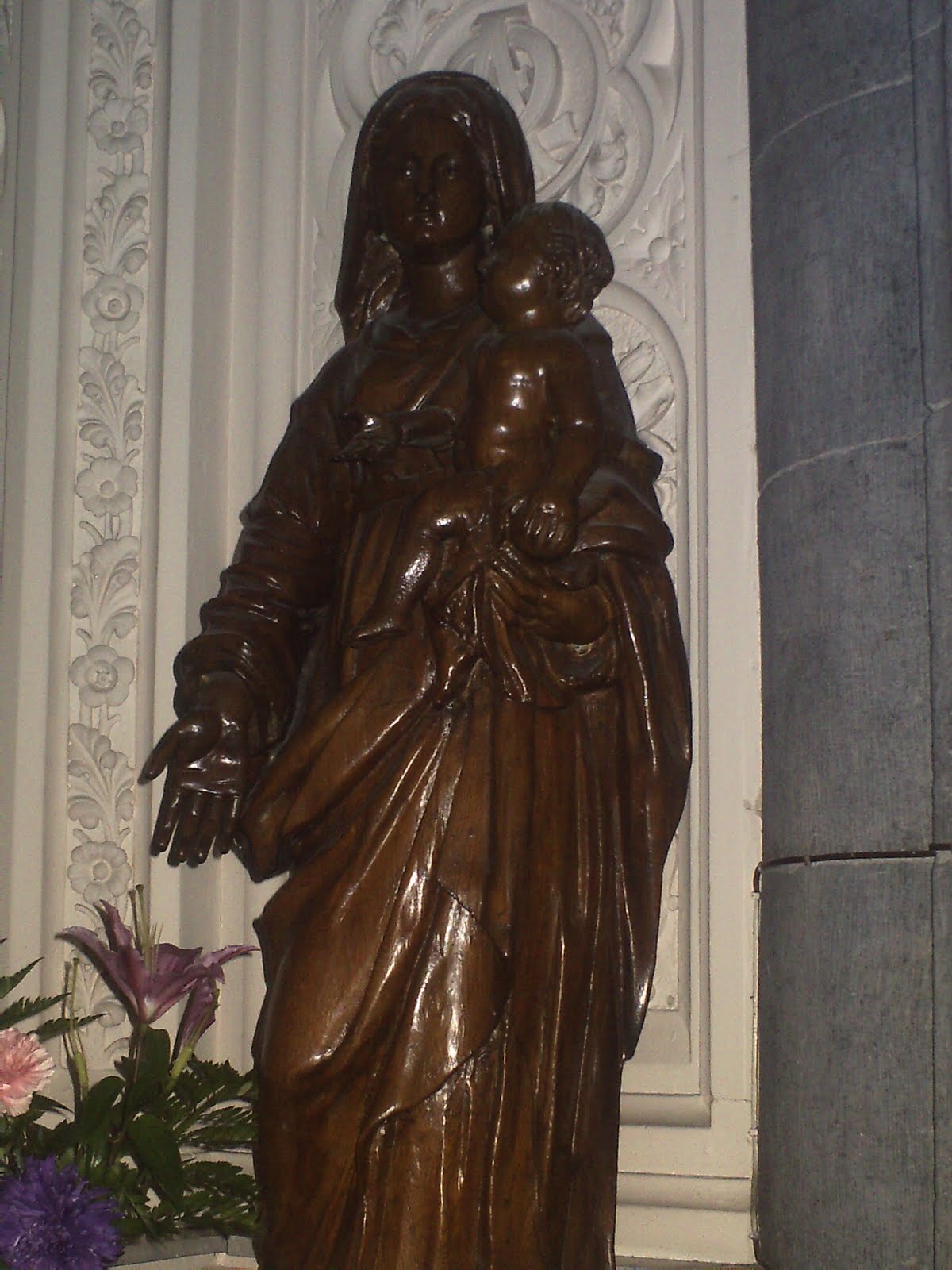 |
| The Black Madonna in regal pose! |
Final word: Thomastown is a very nice and quiet village; and there is also a disused ruined church from the Penal times! So Kilkenny is not just about its city; but has a number of quaint towns, one of which is Thomastown, whose emblem is "The Black Madonna"!
Tuesday, March 23, 2010
"The Cave of the Cat":
Ownee na Gat - entrance to the Otherworld for the ancient Gaels - is perhaps the strangest place in Ireland; a complete enigma, a place beyond comprehension! On the Plains of Cruachan in the townland of the same name, county Roscommon, the demesne of the Connacht royals, it would seem to be aligned to Rath Cruachan itself - the principal Rath of the Connacht Royals! But it's more than just a souterrain, it goes right down into the subterranean chasms, as if some snake plunging headfirst through the Roscommon earth.
But it's its contents, its composition, which is the first of its wide-eyed cornucopia. It seems to hit one in the gut, as if something visceral is at work - as 'though the resonant rapture of wisdom ancient is being illuminated and echoed in the walls. It seemed on one level, not only were the entrails of Mother Earth being shaken and poured from some invisible goblet, as being drained from a tin can, but also my adult consciousness, and hence I had returned to the larvae or bubble and was in my mother's womb again! As if I were floating in water - pacific and tranquil waters of purity, so much so. I had no feeling of claustrophia and indeed didn't want to leave.
The structure and topography of the Cave is most unusual and is another Iris in the wider-eyed cornucopia; the walls, for instance, are layered and textured like the pipes of an organ or like a series of fluted canisters or tubular bells. Could the walls have been stripped by mortals in ancient times, or is it something otherworldly or at least a cameo kaleidoscope of the otherworld! On the ground, I found a stone - not embedded in the ground - but loose - sitting on its side which was either a carving of a Pig, a Cat or a Bull! And then there was the strange mist that appeared in the first picture, I took inside, which appeared to trace the outline and shape of a human!
Could the cave represent a kind of re-birth, re-generation of the individual? A parallel with one interpretation of the Lazarus story - that when going in there, one was metaphorically dead, and when one came out, one was re-born, born again, renewed? The Folklore of Ireland's Saint Patrick, in his cave on Station Island is slightly similiar. (This concept, having been perpetuated from Pre-Christian belief systems). The idea of being plunged into something - full imersion - could also be signified, much like the penitent being plunged into the baptismal waters of renewal (perhaps I touched on that, in my feeling of 'Floating in water'?).
But it would be amiss of me, to not consider the possiblity of it, being a place of initiation and entry for the Royals, given its not more than 100 metres from Rath Croghan. The High King of Ireland, when crowned at Tara, was deemed to be wed to the Mother - the earth. Could the same thing have been at work here for the Connacht Royals? (It's interesting to note there are possibly more Raths in Roscommon, than any other part of Ireland!).
The Cave of Ownnee na Gat is one of the strangest, most curious and logic defying places in Ireland. If one throws into the melting pot, the likelihood that the epic tale from Gaelic mythology 'The Tain' (the 'Cattle raid of Cooley', featuring the Queen of Connacht, Queen Maeve, and the legendary Cu Chulainn) started around here, it's easy to conclude that this was a very important and special area. The Cave of Ownee na Gat could be a real candidate for the erstwhile TV series 'Ripley's believe it or not!'
"The Oarsman":
The oar's angle skimming
the lake's azure pure marble;
As a Barber clip clop trimming
trough swishing - sighs his warble.
Oarsman rowing, ring running,
round ripples as laying corbels
Strokes sighing, sounds punning
cultivating acts with cunning.
Rowing Boat swaying on its back
as clutching the banner spangled
in blue and silver, making track,
as 'though the lake nymph ogled
Oarsman raking hay to sack
the oath Olympic horn bugled!
No flailing arms or wings dishevelled
as music and sport he pulls
From a crowd of waves revelled
his double entendres, nimbly culls!
No time to double O'ER and hunch
as the beams he jousts inch by inch........
 |
| Ownee na Gat - Entrance to the Otherworld |
The structure and topography of the Cave is most unusual and is another Iris in the wider-eyed cornucopia; the walls, for instance, are layered and textured like the pipes of an organ or like a series of fluted canisters or tubular bells. Could the walls have been stripped by mortals in ancient times, or is it something otherworldly or at least a cameo kaleidoscope of the otherworld! On the ground, I found a stone - not embedded in the ground - but loose - sitting on its side which was either a carving of a Pig, a Cat or a Bull! And then there was the strange mist that appeared in the first picture, I took inside, which appeared to trace the outline and shape of a human!
 |
| Outline or body shape? This image was taken when I was looking down the passage from the end of it. I had just sung a song and recited a poem. My friend was at much further down. |
Could the cave represent a kind of re-birth, re-generation of the individual? A parallel with one interpretation of the Lazarus story - that when going in there, one was metaphorically dead, and when one came out, one was re-born, born again, renewed? The Folklore of Ireland's Saint Patrick, in his cave on Station Island is slightly similiar. (This concept, having been perpetuated from Pre-Christian belief systems). The idea of being plunged into something - full imersion - could also be signified, much like the penitent being plunged into the baptismal waters of renewal (perhaps I touched on that, in my feeling of 'Floating in water'?).
But it would be amiss of me, to not consider the possiblity of it, being a place of initiation and entry for the Royals, given its not more than 100 metres from Rath Croghan. The High King of Ireland, when crowned at Tara, was deemed to be wed to the Mother - the earth. Could the same thing have been at work here for the Connacht Royals? (It's interesting to note there are possibly more Raths in Roscommon, than any other part of Ireland!).
The Cave of Ownnee na Gat is one of the strangest, most curious and logic defying places in Ireland. If one throws into the melting pot, the likelihood that the epic tale from Gaelic mythology 'The Tain' (the 'Cattle raid of Cooley', featuring the Queen of Connacht, Queen Maeve, and the legendary Cu Chulainn) started around here, it's easy to conclude that this was a very important and special area. The Cave of Ownee na Gat could be a real candidate for the erstwhile TV series 'Ripley's believe it or not!'
 |
| In the heart of the souterrain - is that an orb? |
"The Oarsman":
The oar's angle skimming
the lake's azure pure marble;
As a Barber clip clop trimming
trough swishing - sighs his warble.
Oarsman rowing, ring running,
round ripples as laying corbels
Strokes sighing, sounds punning
cultivating acts with cunning.
Rowing Boat swaying on its back
as clutching the banner spangled
in blue and silver, making track,
as 'though the lake nymph ogled
Oarsman raking hay to sack
the oath Olympic horn bugled!
No flailing arms or wings dishevelled
as music and sport he pulls
From a crowd of waves revelled
his double entendres, nimbly culls!
No time to double O'ER and hunch
as the beams he jousts inch by inch........
Subscribe to:
Posts (Atom)